
What Does a Design System Cost? Four Levels from Basic to Brand Voice
“How much work is this, really?”
Every time I talk to someone about design systems, the same question comes up: Do I need a designer? How long does it take? What does it cost?
The answer is simpler than most people think — and different from what they expect.
There is no single design system that you either have or you do not. There are four levels. Each is a valid endpoint. You do not need to reach the highest level. You do not even need to plan on getting there.
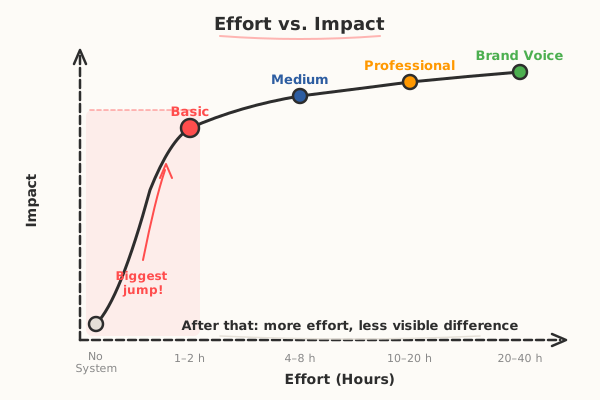
The surprising insight from dozens of projects: the biggest jump in impact happens between “no system” and the first level. After that, each level takes more effort — but the visible difference gets smaller. The curve flattens.
And here is something most people underestimate: at every level, the bulk of the effort is not the implementation. It is the decision-making. Font A or Font B? Red or blue? The third logo concept or the first one after all? If you blog alone and decide alone, you save half the time.
Level 1: Basic — 1 to 2 Hours
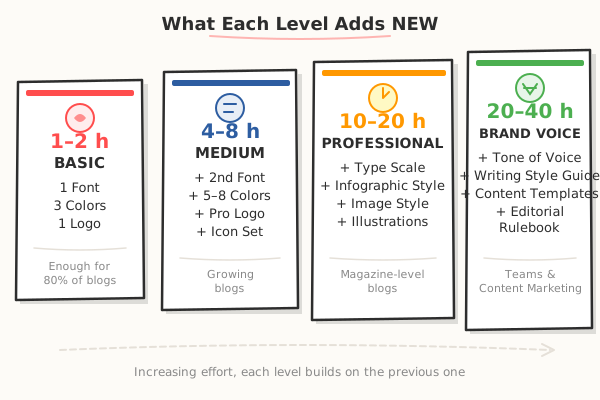
What you get: One font for everything. Three colors — primary, background, text. A simple logo or wordmark. That is it.
Sounds like very little? It is. And that is exactly the point.
What changes: Your blog no longer looks like a default theme. Readers sense a visual signature, even if they cannot name what exactly it is. The font fits the topic. The colors repeat. The logo sits in the top left and reappears as the favicon. Suddenly the whole thing looks intentional — not random.
Effort in detail: 30 minutes for the decisions. Which font? Which color? The rest is implementation: set CSS variables, create or commission a logo, export the favicon. If you are not deciding alone, add one round of alignment — then it is closer to two hours.
Who this is for: Starters setting up their first blog. Hobby bloggers who want to “just get going.” And anyone whose blog has no system at all — regardless of how many articles are already online.
The honest assessment: Level 1 is enough for 80 percent of all blogs. Not as a compromise. As a complete system. Most blogs do not need a second font or an icon set. They need consistency — and it starts here.
Level 2: Medium — 4 to 8 Hours
What is NEW: A second font — for example, one for headings and one for body text. An expanded color palette with 5 to 8 colors instead of three. A professional logo instead of a wordmark. An icon set for recurring elements.
Everything from Level 1 stays. Level 2 builds on top.
What changes: The blog looks professional. Headings stand out from body text — not just through size, but through a different typeface. The colors have a system: primary, secondary, accent, grays. No longer “I picked blue because I like blue,” but “blue for links and buttons, orange for highlights, gray for metadata.”
Effort in detail: Half the time goes to alignment. Which second font pairs well with the first? Which secondary colors? Comparing three logo variants — then picking one. Two rounds of alignment are realistic. The implementation itself is fast after that: extended CSS variables, logo files, icon selection.
Who this is for: Bloggers who publish regularly and want to grow. Blogs with first guest authors who need a clear template. Blogs that want to visually stand out from the competition.
Level 3: Professional — 10 to 20 Hours
What is NEW: A thoughtful typography scale — not just two fonts, but exact font sizes, line heights, and font weights for every hierarchy level. A complete color palette with gray tones and semantic colors (success, warning, error). A custom infographic style. Image editing guidelines: which filters, how to crop, whether to use overlays. Spot illustrations that match the blog.
What changes: The blog looks like a magazine. Every page feels like it belongs — not because everything looks the same, but because everything follows the same rules. Images have a unified look. Infographics match the rest. New pages come together faster because the decisions have already been made.
Effort in detail: The jump from Level 2 to 3 comes from details that require iteration. Typography fine-tuning: how large is H2 relative to H3? How much space between a heading and the first paragraph? The image style needs to be defined and documented — otherwise every photo looks different. Illustrations need to be drawn or commissioned. Two to three rounds of alignment.
Who this is for: Blogs with ambitions. Blogs building an audience where design is part of the brand — food, travel, lifestyle. Teams with multiple authors, where things get inconsistent fast without clear rules.
Level 4: Brand Voice — 20 to 40 Hours
What is NEW: Everything from Professional, plus: tone-of-voice guidelines — how do we write? Casual or formal? A writing style guide with concrete rules on sentence length, form of address, technical terms, word choice. Content templates for different article types — how-to, listicle, case study, opinion piece. An editorial rulebook that defines what gets published and what does not.
What changes: Not just the look is consistent, but also the voice. No matter who writes, the blog sounds like one brand. New authors can write in the right tone immediately because the tone is documented. Readers recognize your articles by style — not just by the logo.
Effort in detail: Most of the time is alignment. Tone of voice cannot be determined in isolation. It needs to be discussed, tested, revised. “Do we write recipe introductions with a personal story or jump straight in?” These are not technical questions — they are identity questions. Three to four rounds of alignment. Plus: building content templates, writing examples, documenting everything.
Who this is for: Blogs with a team. Blogs that operate as a brand. Companies that run content marketing professionally. Publishing-as-a-service projects where multiple authors write for different clients.
Which Level Fits Your Blog?
Three questions are enough:
You blog alone and just started? Level 1. Right now, today. In one hour you will have a system that is better than what 90 percent of all blogs have.
You have been blogging for a year and publish regularly? Level 2. You need a second font, a thoughtful color palette, and a logo that does not look like a Canva template. The next logical step.
Your blog has 50 or more articles and you want it to look like a magazine? Level 3. The investment pays off visibly — every new page benefits from the rules you set once.
You have a team, multiple authors, and content is a business factor? Level 4. Without a documented voice, everyone writes differently. You will notice by the third author at the latest.
Something important: Level 1 is not a compromise. It is a complete system at the level your blog needs right now. Every level is a valid endpoint.
And you can move up a level at any time. Nothing is lost. The work from Level 1 flows into Level 2, Level 2 into Level 3. No starting over, no throwing things away.
Start with Level 1. Today.
A design system does not need to be big to be effective. One font, three colors, one logo — that is more than most blogs have.
The biggest mistake: not starting at all because Level 4 looks too big. The level system exists precisely for this reason — so you do not have to do everything at once.
What a design system contains in detail and why your blog needs one is covered in our foundational article on design systems. That article covers the what and why — this one covered the how-much.
If you want to do it yourself: everything you need is in these two articles. If you would rather hand it off — from the first font to a full Brand Voice — that is what our Operator service is for. We build your design system as part of ongoing blog operations.

Ready for Your Next Project?
Whether it is a blog, a corporate website, or a custom platform – let's build it together. Professional, SEO-optimized, and tailored to your needs.
Start Your Project